3 September 2026

ZhKH 24 Utilities Calculator: work out your family's bill for electricity, water and waste
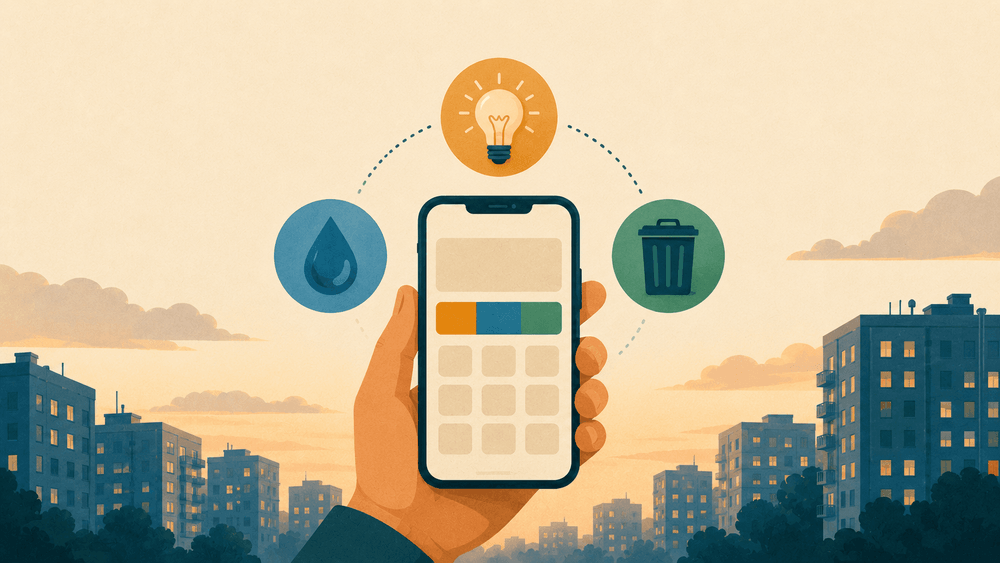
ZhKH 24 calculator: your family's electricity, water and waste bill — plus answers to "what if". Use less? Register one more person? Move to another city? 20 cities, 2026 tariffs, three languages.
The ZhKH 24 analytics desk has gathered current tariffs for electricity, water with sewerage, and waste collection across 20 cities of Kazakhstan and turned them into a single tool. The calculator shows how much a household should pay per month, what the total is made of, and how the number of registered residents changes it.
Why it matters
A utility bill in Kazakhstan is almost impossible to check by eye. Electricity is billed in three tiers, and the threshold of each depends on the number of residents. Water is charged per cubic metre — supply and sewerage separately. Waste is charged per person, at a rate set by the maslikhat (city council) of your particular city. And since 1 January 2026 all of this carries 16% VAT instead of the previous 12%.
As a result, a family sees the total but cannot tell whether it is high or low, or what drives it. The ZhKH 24 calculator answers three questions: how much you should be paying at your level of use, which of the three services takes the biggest share, and what changes if one more resident appears on the account.
How to use it
The tool works in four steps and asks for no personal data.
Choose your city — the list covers 20 cities: the three cities of national significance and 17 regional capitals. Enter how many people are registered in the flat — this sets the cheap electricity allowance and the waste charge. Mark whether you have an electric stove: such homes get higher tier thresholds. Then enter your monthly usage — kilowatt-hours from the electricity meter and cubic metres from the water meter. Both figures are on any bill.
The calculator immediately shows the monthly total and a coloured bar: what share goes to electricity, to water and sewerage, and to waste. Below it — a breakdown per service in tenge.
A separate block is called "The registration paradox". It calculates what happens to the bill if one more actual resident is added to the account: how much electricity gets cheaper (the cheap allowance grows), how much waste gets dearer (one more per-person rate), and the net result — plus or minus. In cities with a flat electricity tariff the calculator says plainly that registration does not affect electricity there.
Anuar Kenesbayev, data analyst, ZhKH 24 analytics desk: "The main thing the calculator does is show the bill as a whole rather than in pieces. People are used to seeing electricity, water and waste as three separate bills from three separate companies. When you add them into one sum and colour it by service, the surprises show up at once. In Karaganda, water and sewerage can cost a family more than electricity. In Almaty, waste for three people is 2,232 tenge — a noticeable line. And in Oskemen, one of the cheapest electricity tariffs in the country sits alongside the most expensive waste charge. Without the full picture you simply don't notice these things."
Electricity, water and waste across Kazakhstan cities. 2026 tariffs incl. 16% VAT.
Play with the numbers: three questions the calculator answers
Checking your bill is only the first step. The real value of the calculator is asking "what if" and seeing the answer in tenge straight away. Below are the three most useful ones, using an Almaty family of three with 300 kWh and 12 cubic metres of water a month: their baseline bill is 13,661 tenge.
What if we use less? Slide the electricity control down. In Almaty the cheap allowance for three people is 270 kWh, and a family using 300 overpays for the extra 30 at the highest rate. Cut usage to 270 — the bill drops by 1,273 tenge. Cut another 30 — the saving grows to 2,236 tenge. In the other direction it is far steeper: an extra 100 kWh above 300 costs 4,242 tenge, because every one of them is billed at Tier 3, 53 tenge per kilowatt. Water is gentler: three cubic metres a month is 373 tenge — each cubic metre in Almaty costs 124 tenge including sewerage.
What if we register one more person? Press "plus" in the "Registered" field. The calculator shows both sides: electricity gets cheaper because the cheap allowance grows by another 90 kWh, but waste gets dearer by 744 tenge — the maslikhat's per-person rate. For the Almaty family at 300 kWh the net result is plus 434 tenge: the electricity saving does not yet cover the waste charge here. But try the same move at 400 kWh, or in Oral — and the sign flips to minus. And if only one person is registered instead of the three who actually live there, the family overpays by 1,856 tenge a month. This effect is explored in detail in our piece "The Registration Paradox".
Read also:
What if I lived in another city? Change nothing but the city — and the calculator re-prices the same family at another city's tariffs. Almaty's 13,661 tenge becomes 13,119 in Astana, 13,327 in Karaganda (dearer water, cheaper electricity), 14,532 in Oral, and 8,666 in Semey. The gap between the most and least expensive city for an identical family is 1.7 times. It is a handy way to see what utilities really cost when relocating — and to discover that a city expensive for electricity can be cheap for water.
There is a fourth switch too — "Electric stove". Such homes get a noticeably wider cheap allowance per person, and one click shows by how much.
How the data was collected
The calculator runs on a tariff database the ZhKH 24 analytics desk compiled from open sources in August–September 2026. For each service, primary sources of the appropriate level were used.
Electricity — official tariffs of power supply companies (Alatau Zharyk Company JSC, Astanaenergosbyt LLP, OESK JSC, MREK JSC, ZKO REK LLP, KREK JSC and others) and orders of the regional departments of the Committee for Regulation of Natural Monopolies. Per-resident tier thresholds and rates for homes with and without electric stoves are taken into account. For East Kazakhstan and Abai regions, OESK JSC tariffs in force since 15 August 2026 are used.
Water and sewerage — municipal water utility tariffs for metered households, from the utilities' official websites and DKREM orders. For Astana the increase from 1 April 2026 is included; for Shymkent, the period in force from 1 July 2026.
Waste collection — decisions of city maslikhats and official akimat announcements, the rate for serviced housing per resident per month. For Oskemen the 757-tenge rate under maslikhat decision No. 46/2-VIII of 16 June 2026, in force from 1 September, is applied.
All rates are brought to a single basis — including 16% VAT.
Caveats: where the data is incomplete
The ZhKH 24 analytics desk considers it important to state the limits of the tool's accuracy plainly.
For four cities — Oral, Petropavl, Pavlodar and Turkistan — water and sewerage tariffs are taken from regional media, because the utilities' official websites were unavailable at the time of collection or do not publish the tariff. We treat these figures as indicative until confirmed by DKREM orders. In Pavlodar, moreover, the water tariff is being contested in court.
In Atyrau, Pavlodar and Turkistan the water tariff is tiered by volume; the calculator uses the base rate of the first block, so with high water usage the actual bill will be higher than calculated.
Some water tariffs were set by orders issued while VAT was still 12% (Konaev, Kyzylorda, Taraz); the "incl. 16% VAT" rate for them has been recalculated by us. For Mangystau region the supplier publishes the electricity tariff only excluding VAT (20.67 tenge); the 23.98 rate including VAT is our calculation.
Waste tariffs are given for serviced housing; in several cities different rates apply to private houses. Unmetered flats are billed for water by a per-person norm — the calculator does not model that regime.
The calculator is for reference. The final amount on your bill is set by the supplier; where figures differ, rely on the bill and confirm the rate with the supplier.
The calculator works in Russian, Kazakh and English — the interface language switches with a single setting. The tool is self-contained, sends no data and requires no sign-up. Newsrooms and portals may embed it on their sites with a link to ZhKH 24 as the data source.
Prepared by the ZhKH 24 analytics desk from open sources. Tariffs current as of September 2026; the database is updated as new orders and decisions are issued.