24 September 2026

Управление кондоминиумом в Китае: сравнение по городам — и с Казахстаном
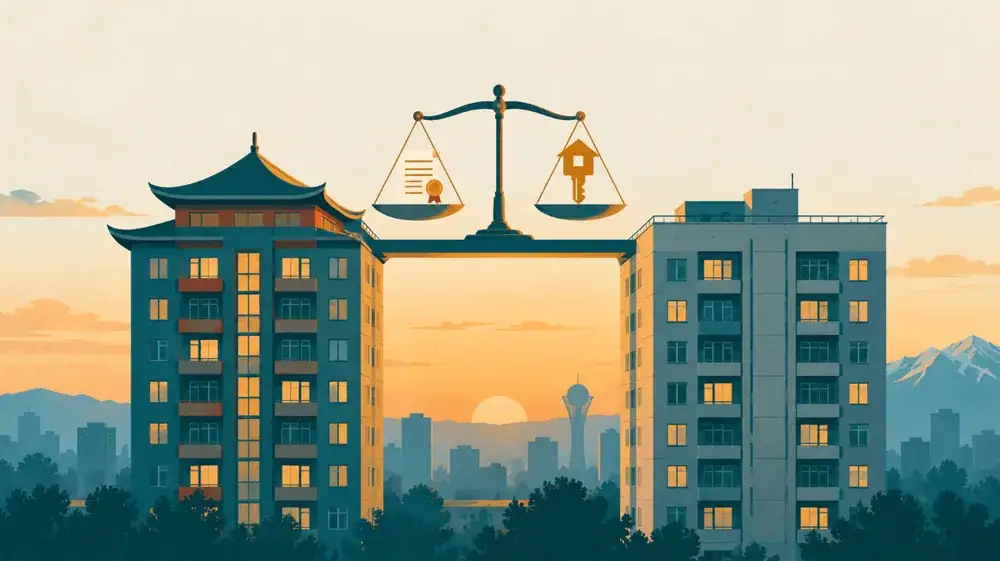
ZhKH 24 analysts compare condominium management in China (Shanghai, Shenzhen, Hangzhou) and Kazakhstan: chairperson, house council, legal entity, quorum. Key gap: China's committee lacks legal status.
The ZhKH 24 analytics desk studied how condominiums are managed in China — a country with no unified housing code, where voting rules, house council composition, and even the number of residents needed to hold a meeting differ from city to city. We break down how Shanghai differs from Shenzhen and Hangzhou, and compare the Chinese model with Kazakhstan's — on chairperson, house council, legal entity status, the property manager, and quorum.
The main finding
China has no equivalent of Kazakhstan's Law "On Housing Relations" — a single national act describing an HOA, a house council and a chairperson for the whole country. The general principles come from China's Civil Code (in force since 2021, inheriting the norms of the 2007 Property Law): owners have the right to form an assembly and a committee, and some decisions require a supermajority. But the specifics — how many people sit on the committee, how quorum is counted, whether an e-voting system is required, who can dissolve the committee — are set by each city or province in its own property management regulation (物业管理条例). So there is no single correct answer to "how does China manage a condominium": Shanghai, Shenzhen and Hangzhou are three different models sharing a common core but differing in the details.
The second systemic difference from Kazakhstan runs deeper than house council composition: across most of China, the owners' committee (业主委员会) — and, even more so, the owners' assembly (业主大会) — still has no legal entity status. This is not a technicality; it is the root of a years-long Chinese debate over who should be liable for a building's debts and in whose name a lawsuit against a dishonest management company should be filed.
How management is structured at the national level
China's Civil Code (which inherited Articles 75–82 of the 2007 Property Law) describes two bodies: the owners' assembly (业主大会) — all owners of units in a building or complex — and the owners' committee (业主委员会) — an elected executive body that represents the assembly on day-to-day matters.
Voting at the assembly is split into two thresholds:
— for most matters (bylaws, rules, the contract with a management company, electing and re-electing the committee), a simple majority is enough — over half the votes by area and over half by number of owners taking part in the vote;
— for "heavy" decisions — raising and spending a capital repair fund, renovation, or changing the purpose of common property — a two-thirds vote is required, by area of premises and by number of owners simultaneously.
Decisions of the assembly and the committee are binding on all owners in the building, including those who voted against or did not take part; they can only be challenged in court, and only if a decision infringes a specific owner's rights.
From there, the differences become regional: exactly how to convene a meeting, how many people must sit on the committee, what to do if a meeting simply cannot be organised at all (a common situation in China — such a building is then handled not by the owners but by a specially appointed temporary body) — all of this is regulated at city or province level.
Three cities, three models
| Shanghai | Shenzhen | Hangzhou | |
|---|---|---|---|
| When the assembly is formed | ≥50% of floor area sold and handed over, or 2 years since the first unit was sold | Once the building is ready, governed by the 2022 regulation | Since 1 March 2022 (2024 revision) |
| Assembly quorum | ≥2/3 of floor area and ≥2/3 of the number of owners | Aligned with the Civil Code — in practice 2/3 of those present | Ordinary matters — over half of area and number; "heavy" matters — three quarters |
| Committee size | Odd number, from 5 (from 3 for buildings under 10,000 m²) | Not rigidly fixed; the key feature is a two-round election | 3–11 people, an odd number |
| Committee term | 3–5 years | — | 3–5 years |
| Distinctive mechanism | Developer-funded committee office space — from 30 m² | Two-round election system, due to the city's high population mobility | A temporary "property management committee" if the assembly is never formed |
| Digitalisation | — | — | A mandatory, free e-voting system |
The figures in the table should not be relied on fully for legal purposes — Chinese cities revise their regulations almost every year, and there are no official translations; sources and caveats are given below.
Why Hangzhou has a voting app and Shanghai didn't
The difference isn't technical — all three cities are equally capable of running a digital platform. The question was whether the local property management regulation allowed it, and who ends up building that platform: the city, or the market.
China has ended up with two parallel solutions in practice. The first is state-run: since 2020, Hangzhou has issued residents an "electronic owner card" (电子业主卡) — a digital identifier from the city's Housing Security and Real Estate Administration (杭州市住房保障和房产管理局), used to vote at assemblies from a smartphone. It is an official municipal service, written directly into the property management regulation as a mandatory option. The second is private: commercial voting services such as "Ding Dong Go Vote" (叮咚去投票) have existed on the market for years, bought directly by management companies and owners' committees regardless of whether their city has an official platform at all.
And here the private solutions turned out to be the stronger ones in practice — which is exactly why they appeared in China before the municipal systems did, and why they keep growing in cities with no state service whatsoever. Commercial platforms for owners' assemblies typically offer what the basic city system doesn't: a full meeting-organisation cycle (sending out the agenda, collecting signatures for an initiative, separate electronic ballots for each individual question rather than one blanket "for/against"), automatic calculation of quorum by area and by number of owners at once (that "two-threshold" requirement that's awkward to tally by hand), an archive of minutes and a digital trail of votes for any future court dispute, and integration with messaging apps (WeChat) — meaning a resident doesn't need to install a separate app or wait for the city to issue its own card. Hangzhou's state platform solves a narrower task — confirming an owner's identity and the legal validity of a vote — but it doesn't replace the whole process of preparing and running a meeting, which private services usually work through in far more detail.
That's exactly why, in cities without a state platform (Shanghai — until recently — Shenzhen, and most others), meetings were held for years not only through paper ballots collected door to door (the press calls this "扫楼式" — "sweeping the building") but also through such private services — the local regulation neither required them nor banned them, and the market closed the gap faster than the municipalities did. That changed just days before this piece was prepared: on 18 September 2026, the Standing Committee of the Shanghai Municipal People's Congress (34th session of the term) approved an amendment explicitly allowing owners' assemblies to be held online via the municipal platform for the first time; the amendment takes effect on 1 November 2026. It is framed as a recommended, not mandatory, method, leaving the choice of tool to the owners' committee itself — meaning private services remain a legal, and probably more capable, option there too.
The same Shanghai amendment introduced another institution — the property governance committee (物业治理委员会, not to be confused with the ordinary 业主委员会). It is set up by grassroots authorities ("乡, 镇" — township and town administrations) in temporary cases: when owners fail to elect a committee within the required timeframe, or fail to complete its re-election. Such an appointed committee's powers are capped at two years and end automatically once the building elects its own committee — a construction that almost exactly mirrors Hangzhou's temporary committee, only arriving in Shanghai four years later.
Hangzhou: the assembly, the committee, and the "ownerless building"
Since Hangzhou was the city specifically asked about, here is what its current property management regulation shows (the latest revision was adopted by the city congress on 29 December 2023 and approved by the Zhejiang provincial congress on 29 March 2024, taking effect with updates in 2024; the base version has applied since 1 March 2022).
The owners' assembly is convened either by the committee or by an initiative group of at least 20% of owners; notice is sent 7–15 days in advance, voting itself can run from 5 to 60 days, and an electronic form is allowed — a requirement Hangzhou makes mandatory, obliging the management company to make it convenient and free for residents.
The owners' committee is elected for 3–5 years, made up of 3 to 11 people (an odd number, to avoid tied votes), with a chairperson and one or two deputies elected from within the committee itself. Committee members are explicitly banned from receiving any benefit from the developer or the management company — a conflict of interest is written in as grounds for removal. Twice a year the committee must publish a financial report, minutes of decisions, and data on the use of its official seal — a mechanism far more detailed than anything in Kazakhstani law.
The most unfamiliar institution for a Kazakhstani reader is the property management committee (物业管理委员会). This is not an owners' committee, but a body set up by the district (street-level) administration in a building where an owners' assembly has simply never been organised — a common situation for buildings with a high share of rented-out units or a large number of absentee owners. It has 7–11 members, at least half of them owner representatives, but the chairperson of such a temporary committee is appointed by local government, not by residents. Formally this is a temporary measure, capped at two years, meant to get a "normal" assembly running — but in practice, in some buildings such a committee operates for years.
Why this matters — explains Anuar Kenesbayev, data analyst, ZhKH 24 analytics desk: "Kazakhstani law has a similar idea — a temporary house council chairperson for up to six months if the sitting one can't perform their duties. But that's an exception for one person, for a short period. In Hangzhou, and in China generally, temporary management of a building by the local administration is a built-in, routine mechanism for when residents simply couldn't get organised. Our law assumes a building will eventually organise itself, sooner or later; China's legislator has explicitly accepted that a substantial share of buildings never will, and solved that problem through the participation of the street-level committee rather than by forcing residents to comply."
Kazakhstan has an "ownerless building" too — it's just solved differently
Here the comparison with China's temporary committee needs a correction: in Kazakhstan, if a building's owners haven't chosen any management form at all (or split their votes at the assembly), the law provides its own backup mechanism — not a committee of residents, but a temporary management company appointed by the housing inspectorate. The inspectorate announces a tender on the local akimat's website; companies submit applications within 10 working days; a commission reviews them over 5 working days; and the applicant offering the lowest price wins. The appointment is finalised within 3 working days, and the contract follows a standard template. Such a company cannot be appointed if its tax debt exceeds six times the monthly calculation index, or if it is in bankruptcy proceedings. Its term is up to one year: if the building settles on a management form within that time, it may knowingly continue working with the same company; if not, the inspectorate runs a fresh tender for another term.
The contrast with the Chinese model is telling: in Hangzhou and Shanghai, an "ownerless building" temporarily gets people — a temporary committee of appointed representatives, some of whom are still owners in that same building. In Kazakhstan, the same situation gives the building an organisation — a commercial management company selected on price, with no say from the residents themselves. The first model stays closer to self-governance even in a crisis; the second is faster and more predictable for service continuity, but leaves residents less room to influence who actually runs their building until they manage to organise themselves.
Legal entity status — the biggest divide
This is where the Kazakhstani and Chinese models diverge most sharply. In Kazakhstan, an HOA (property owners association) is a non-profit organisation — a legal entity registered with the justice authorities, with its own seal and bank account, and able to sue and be sued in its own name. After the 2025–2026 reform, Kazakhstan formally has two legal management forms left — the HOA, and direct joint management (available to buildings with fewer than 36 owners, requiring no bank account and no mandatory legal entity, with decisions made by meeting minutes). What used to be the KSK (apartment owners' cooperative) hasn't been abolished by the reform, but it is no longer left as an equal management form either — it is now a management entity: an organisation that a building (including several buildings at once) can hire to run the household, on a par with a private management company. It still holds legal entity status.
In China, the owners' committee (业主委员会) has no independent legal entity status in the vast majority of regions. Formally, rights and obligations belong not to the committee but to the owners' assembly itself — and the assembly, in turn, is usually not a legal entity either. This is not a legal nicety: Chinese courts have disagreed for decades over whether an owners' committee can independently sue a dishonest management company, or whether it must first collect powers of attorney from every owner in the building. The question of "法人化" — granting legal-entity status to the owners' assembly — has been debated in Chinese legal scholarship for more than ten years; individual provinces and cities — Chongqing and parts of Jiangsu are among those cited — have floated pilot proposals to grant the committee quasi-legal status, but no unified national solution has been adopted. In March 2026, deputies of the National People's Congress explicitly pointed to the 2009 baseline regulation as outdated and proposed either urgently revising it or adopting a separate law on residential property management — meaning that, at the time this material was prepared, the question remains open even for Beijing itself.
Comparison table: China and Kazakhstan
| Parameter | China (general contour + regional variation) | Kazakhstan (after the 2025–2026 reform) |
|---|---|---|
| Base law | China's Civil Code sets the general contour; the specifics come from each city/province regulation (物业管理条例) — there is no single national housing law | A single Kazakhstani Law "On Housing Relations" applies across the whole country |
| Chairperson | The owners' committee chairperson is elected by committee members from among themselves, not directly by the assembly | The HOA chairperson is elected directly by the assembly for a 3-year term and must sit on the house council |
| House council / committee | Owners' committee (业主委员会) — 3–11 people (Hangzhou), from 5 (Shanghai); separately, a temporary property management committee appointed by the administration if no assembly is ever formed | The house council — a standing body attached to the HOA/KSK, at least 3 people; the chairperson must be a member |
| Legal entity | Usually neither the committee nor the owners' assembly has one; the "法人化" question has been debated nationally for over 10 years, unresolved | Yes — for the HOA (a management form) and the KSK (a management entity hired by the building); no legal entity is required at all for buildings with under 36 owners (direct management) |
| Manager / management company | Hired by the assembly through a tender (in Shanghai, mandatory open bidding on the municipal platform); can be replaced by assembly vote before the contract expires | Since 2025, hiring a professional manager under an employment contract is allowed with house-council approval; the manager must hold a qualification document and be a citizen of Kazakhstan |
| Quorum for ordinary decisions | Over half of participants by area and by number (national norm); Hangzhou — the same | Over half of the total number of owners taking part in the assembly; decisions pass by a majority of those who voted |
| Quorum for "heavy" decisions | Two-thirds of votes by area and by number of owners simultaneously | A majority of the total number of all owners in the building (not just those voting) — for nine categories of matters: the budget, contributions, capital repairs, choosing a manager, and others |
| What happens if residents don't organise | The local administration forms a temporary committee of people — 7–11 members, at least half of them building owners (Hangzhou; Shanghai from September 2026); term up to 2 years, ending automatically once a regular committee is elected | The housing inspectorate appoints a temporary management company by tender (lowest price wins) for up to 1 year; separately, a temporary house-council chairperson for up to 6 months if the sitting one cannot perform their duties |
| Electronic / online voting | Two parallel solutions: a municipal platform ("electronic owner card"; mandatory option in Hangzhou since 2020, recommended option in Shanghai from 1 November 2026) and private commercial services (e.g. "叮咚去投票"), which are often more capable and work in any city regardless of the local regulation | Not separately provided for by law; voting is by in-person meeting or written poll under minutes |
| Changing the management form | Governed by local regulation, varies by city | Since September 2026, a building with 200+ owners cannot switch from HOA to direct management earlier than one year after choosing the HOA form |
| Regional variation | Substantial — every major city has its own regulation (Shanghai, Shenzhen, Beijing, Hangzhou and others) | None — the law is uniform across the republic |
What this means for a Kazakhstani reader
The comparison isn't about who does it better — it shows two different philosophies for solving the same problem: what to do with a building whose owners can't or won't organise themselves. Kazakhstan chose the path of unification: one law, one procedure, mandatory chairperson membership on the house council, a professional-qualification requirement for the manager, and fines for missing document-handover deadlines when a manager changes. China chose the path of regional flexibility with a built-in backup mechanism: if residents don't organise themselves within a reasonable time, the local administration temporarily does it for them. The flip side of China's flexibility is exactly that uncertainty over legal-entity status, which makes it harder for an owners' committee to sue a dishonest management company than it is for a Kazakhstani HOA.
The city closest in spirit to the Kazakhstani model is Hangzhou, with its requirement of free electronic voting and mandatory publication of the committee's financial report every six months — a point that could be a direct reference for Kazakhstani HOAs too, where financial-transparency requirements remain one of the weaker spots in enforcement.
Caveats and the limits of this research
This material is not legal advice and does not replace consultation with a qualified lawyer working with PRC law.
The Shanghai amendment on online assemblies and the property governance committee was adopted on 18 September 2026 but only takes effect on 1 November 2026 — at the time this material was published, the rule was not yet in force.
Chinese property management regulations have no official translation into Russian or English; the wording in this article is a rendering from primary sources and open legislative databases, not a literal translation. China's regulatory base is revised almost annually at city and province level (Hangzhou and Shenzhen have each revised their regulations several times in the past five years), so some details may be out of date by the time you read this — first and foremost the numeric thresholds for quorum and committee composition.
Shanghai, Shenzhen and Hangzhou were chosen for comparison as major cities with regulatory texts accessible in English and Chinese; Beijing, Guangzhou, Chengdu and other megacities are not covered here and may differ from the models described. Data on the legal-entity status of owners' committees reflects the general national picture; in individual pilot districts the status may be more advanced than described.
For Kazakhstan, the current edition of the Law "On Housing Relations" and the condominium management rules were used, accounting for changes that took effect on 15 September 2025 and 14 September 2026.
Prepared by the ZhKH 24 analytics desk from open sources, including official publications of PRC and Kazakhstani legislation. Prepared: September 2026.