8 October 2026

E-KNOT at GDTE 2026 in Hangzhou: quorum, smart intercoms and partners for Central Asia

E-KNOT tells China how it solves the quorum problem in housing E-KNOT showcased its building-management platform in Hangzhou — and found that collecting owners' quorum is a concern for Chinese property managers too: the trip's results include a WeChat pilot and a smart-intercom partnership.
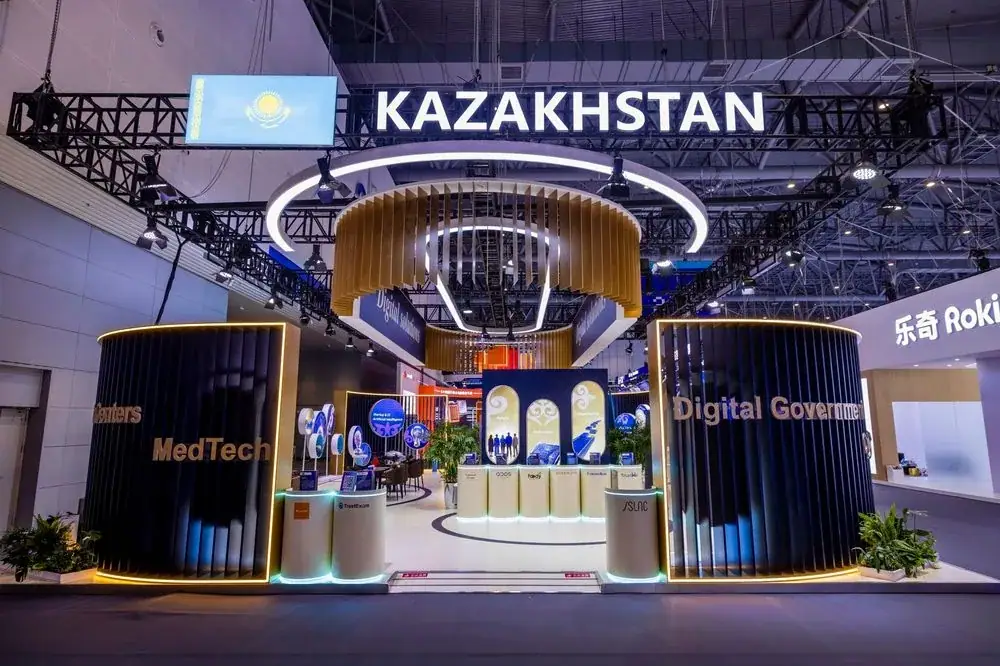
The Kazakhstani company E-KNOT, a developer of a platform for managing multi-unit residential buildings, took part in the 5th Global Digital Trade Expo (GDTE 2026) in Hangzhou, China, as part of Kazakhstan's national pavilion. Over five days the team held more than 20 meetings and negotiations. The main outcomes of the trip: Chinese property management companies' interest in E-KNOT's technology for collecting quorum at owners' meetings, and an agreement with a hardware manufacturer on a joint solution for Central Asia. A pilot batch of "blank" devices is already in preparation; E-KNOT will install its firmware in Kazakhstan.
The expo: 170,000 sqm and artificial intelligence
The organisers call GDTE the only national-level international expo in China dedicated to digital trade. It is hosted by China's Ministry of Commerce and the Zhejiang Provincial People's Government.
The fifth edition ran from 23 to 27 September 2026 at the Hangzhou Grand Convention and Exhibition Center under the slogan "Meet the AI Future at GDTE." The exhibition covered 170,000 square metres.
According to Xinhua, 2,008 companies took part in person, almost half of them (996) from the AI sector — roughly three times more than the year before. The expo drew over 50,000 professional buyers, including more than 12,000 from abroad. A total of 428,000 visits were recorded and 226 premieres presented. Among the foreign exhibitors, the agency singled out delegations from France, South Korea, Peru, Kyrgyzstan and Kazakhstan.
The central theme was artificial intelligence — from computing infrastructure and large models to "smart" hardware. Malaysia and Hungary were guest countries of honour, and a dedicated programme was held for "Silk Road E-Commerce Day."
According to E-KNOT founder and director Vitaliy Pustovoitenko, GDTE is a venue where it is immediately clear where China's digital economy is heading, and it was important for the company to show that Kazakhstani housing-and-utilities technology is of interest not only in the region but to China itself.
What E-KNOT presented
E-KNOT showed its platform — a single app for residents, HOAs and property management companies. The company has operated since 2020, is headquartered in Astana, and its platform is used by more than 100,000 people.
Key modules on display included:
- online voting for owners with ownership verification;
- access control — intercoms, barriers, gates;
- a dispatch service with AI-powered request handling;
- payment collection and debt-management automation;
- monitoring of engineering systems. For the Chinese side, E-KNOT positioned itself not as a buyer but as a partner. To property management companies it offers help collecting quorum; to hardware manufacturers, access to the Central Asian and Russian markets, with a combined population of roughly 220 million.
"We came to China not to shop, but for partnership. Chinese companies have strong manufacturing; we have experience working with buildings and an understanding of the Central Asian and Russian markets. Together this works better than apart," Pustovoitenko notes.
AI in housing management — already a working tool
Artificial intelligence, the expo's main theme, is nothing new for E-KNOT. The company actively uses AI in the platform's daily operation. It routes residents' requests to contractors, talks to residents and answers routine questions, and tracks deadlines, flagging overdue work in time.
"In Hangzhou, AI was on display everywhere — from robots to large models. But in housing management its value lies elsewhere: it has to take the routine work off people's hands. Our AI receives and routes requests, replies to residents, and makes sure contractors meet deadlines. The dispatcher is no longer drowning in calls, and the resident can see their request wasn't lost. For the management company that means transparency; for the resident, trust," says Vitaliy Pustovoitenko.
Quorum: a problem China knows too
What drew the most interest from Chinese visitors, property management companies above all, was the technology for securing quorum in owners' votes. It turned out that collecting votes is an acute problem for Chinese residential complexes as well.
China's equivalent of an owners' meeting is the 业主大会 (owners' assembly). Voting requirements are set out in Article 278 of the PRC Civil Code. A vote requires the participation of owners holding no less than two-thirds of the floor area and making up no less than two-thirds of all owners by headcount. Ordinary decisions are passed by a majority of participants, both by area and by headcount. The most serious questions require three-quarters of participants on both measures — among them raising funds for a repair reserve, reconstructing a building, and changing the designated use of common property.
In practice, voting in China largely remains paper-based. The owners' committee (业主委员会) prints ballot sheets and puts up notices, while volunteers go door to door collecting signatures. In a complex of 1,000 flats, at least 667 owners must take part for a vote to be valid at all.
According to people E-KNOT spoke with at the expo, collecting the sheets can drag on for months: owners rent out their flats, live in other cities, or simply don't answer the door. In many complexes the threshold goes unmet for years. Kazakhstani HOAs know this problem well.
According to the company, more than 2,000 votes have already been held on the E-KNOT platform, and in buildings with over 2,000 residents the company has managed to collect quorum within three months, in line with legal requirements.
"We've come a long way. When we started, even online we weren't collecting more than 30% of votes. Now we've learned to collect 50% and more. A lot depends on how close-knit the building is, but on the whole we know how to do it. Essentially it's marketing aimed at residents: the management company has a CRM on its residents, and we help it understand their problems, solve them, and call people to vote. Only a combined approach across many communication channels works," Vitaliy Pustovoitenko said.
By his own account, the sheer acuteness of the quorum problem in China came as a surprise to the team: despite a high level of digitalisation — sensors, hardware — the human factor remains, and E-KNOT happens to have experience working with people when data is scarce.
The two sides agreed on a pilot with Chinese property management companies. The solution will take Chinese legal requirements into account and run through WeChat — China's main messenger, familiar to residents. E-KNOT plans to launch the WeChat version by December, and in January, together with its Chinese partners, begin preparing the pilot, including localisation into Chinese.
Read also:

A smart intercom without replacing the intercom
The second topic of negotiations was integrating the platform with IoT devices. By the end of the expo, E-KNOT had agreed with a Chinese manufacturer on a joint product for the Central Asian market — a module made to the company's specification.
The partnership model is simple. The manufacturer supplies universal hardware with no firmware, and E-KNOT installs and protects its own firmware. A pilot batch of "blank" devices is already in preparation; they will be flashed in Kazakhstan.
For buildings, this means affordable modernisation: there's no need to remove the existing intercom — installing the module is enough. It is compatible with all common intercom types, including analogue ones. Once installed, the door can be opened from a smartphone, one-time links can be issued for guests and couriers, and the management company can see an access log. By the company's estimate, modernising one entrance costs roughly 20,000–30,000 tenge.
The module is currently undergoing cold-weather testing. The manufacturer claims it works in freezing conditions, but E-KNOT wants its own data from an Astana winter.
According to Pustovoitenko, the code belongs to the company, so it can develop the solution and add features quickly; E-KNOT continues to work on firmware-protection mechanisms. A building doesn't need to replace its intercom — the company makes the one already installed smart, something even a small HOA can afford. E-KNOT is now building out a partner network and inviting partners from other cities.
Other hardware makers from Hangzhou and Shanghai also showed interest in integrating with the platform, including developers of patrol robot dogs and window-washing drones.
[Photo 3: the intercom module / devices at the expo]
A barrier shouldn't hold up an ambulance
In development is a device that will let ambulances, police, fire crews and emergency services pass into courtyards unimpeded.
Pustovoitenko recalls often seeing an ambulance stuck at a closed barrier, sounding its horn for three to five minutes or longer until someone opens it. When it comes to an ambulance, he says, that's no longer a matter of convenience but of life.
The new device will open the barrier for emergency vehicles automatically on signal, without security staff or residents needing to act. In parallel, the company is working on recognising a specific audio signal and exploring the use of AI for this task.
Hangzhou students — for internships in Astana
Another unexpected topic was internships. At the expo, students from Hangzhou approached E-KNOT, interested in a work placement at the company. The two sides exchanged contacts and are discussing a possible format.
For E-KNOT this is familiar territory: the company has long worked with Kazakhstani universities. Experience shows that students are a convenient way to test hypotheses and run research. Some of the innovations on the E-KNOT platform emerged precisely from joint work with Kazakhstani universities.
According to Pustovoitenko, this came as a surprise to the team: students pick up tasks quickly and aren't afraid to try something new, and many of the platform's hypotheses were first tested together with Kazakhstani universities. If Chinese students join this work too, the company expects to gain a perspective from another market as well.

Kazakhstan's pavilion: translators turned salespeople, and neighbours who became partners
The participation of Kazakhstani companies was organised by Kazakhstan's Ministry of Trade and Integration and QazTrade. The national pavilion featured 28 companies, mostly from artificial intelligence, cloud technology, data centres and medical technology. The stand drew many visitors, and every exhibitor had their own interpreter assigned.
The interpreters' approach was a particular surprise. Back in Kazakhstan they had already familiarised themselves with each company's products and got into the subject matter, so at the expo they didn't just translate — they effectively worked as sales managers, having studied the product in advance and speaking to visitors in the same language as the E-KNOT team.
"I want to thank the Ministry of Trade and Integration and QazTrade. The organisation was excellent," Vitaliy Pustovoitenko noted.
Another unexpected upside was the connections made inside the pavilion itself. Kazakhstani exhibitors talked not only with Chinese visitors but with each other, and E-KNOT ended up finding two potential partners among its compatriots. According to Pustovoitenko, sometimes you have to fly to China to meet your neighbour: back home companies are often absorbed in their own work and never cross paths, but at the expo they ended up side by side, got talking, and found two potential partners. For E-KNOT that's as much a result of the trip as the Chinese contacts.

What's next
Once it receives the pilot batch, E-KNOT will test the hardware in residential buildings in Astana, including through the winter. In parallel, the company is preparing a WeChat voting version. The next stop is TAITRONICS & AIoT Taiwan 2026 in Taipei, 20–22 October, where E-KNOT will continue looking for IoT hardware partners.
According to Pustovoitenko, the pilot in Astana will show how the solution performs under Kazakhstani conditions, winter included, and beyond that the company expects to scale across Central Asia and test WeChat-based voting in China.
This material was prepared based on information provided by E-KNOT.