29 October 2026

Implementation of President's Address Strategies in Gas Sector Discussed in Astana
The implementation of strategies from Kazakhstan's President's Address in the gas sector was discussed in Astana, focusing on innovative approaches to geological exploration and gas infrastructure dev
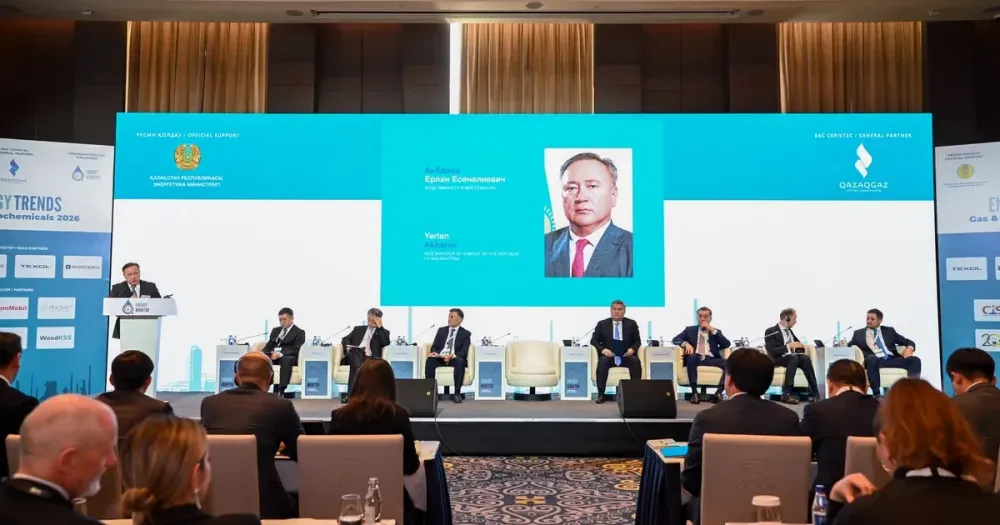
In Astana, the Energy Trends: Gas & Petrochemicals expert panel, organized by the public foundation 'Energy Monitor', saw a detailed discussion on practical mechanisms for developing Kazakhstan's gas and petrochemical industries.
Representatives from the Ministry of Energy of Kazakhstan, national companies 'QazaqGaz' and 'KazMunayGas', private subsoil users, and the expert community reviewed the entire production chain of the sector - from exploration and discovery of new deposits to gas transportation and production of high-value products.
The key focus of the meeting was on implementing the tasks set by the Head of State, Kassym-Jomart Tokayev, in his Address to the Nation of Kazakhstan. These tasks include a radical update in approaches to geological exploration, transforming geology into a high-tech industry, attracting private capital to subsoil study, and developing the gas infrastructure and advanced raw material processing for the needs of the national economy.
Speaking at the working session, Deputy Minister of Energy of Kazakhstan Yerlan Akbarov emphasized that sustainable development of the gas industry and reliable regional gasification begin with quality subsoil study and the accuracy of geological data. Currently, the approved recoverable gas reserves in the republic amount to almost 4 trillion cubic meters (more than half of which is associated petroleum gas), and the annual production of commercial gas is maintained at over 27 billion cubic meters. Meanwhile, domestic consumption is dynamically growing and is expected to exceed 22.5 billion cubic meters this year, driven by the gasification of settlements, economic growth, and the transition of industrial facilities to environmentally friendly fuel.
To synchronously expand the raw material base and processing capacities, the introduction of four new gas processing plants with a total capacity of 9.4 billion cubic meters of raw gas per year is planned.
"Having geological reserves does not automatically mean having market-ready gas. Investments, modern technologies, and coordinated infrastructure development are necessary. Every new plant should have confirmed sources for long-term loading. This is why the Ministry of Energy is developing an industry development program with horizons for 2030, 2035, and 2040, rigorously linking subsoil study, extraction, and processing with the prospective needs of the population and industry," noted Deputy Minister Yerlan Akbarov in the announcement.
In executing the President's instructions on comprehensive subsoil research, the Ministry is focusing on unlocking the potential of 11 under-explored sedimentary basins in the country (out of 15 existing). The Subsoil Code includes preferences for complex deep deposits, and active subsoil users are allowed to extend the boundaries of their fields up to five kilometers without new auctions. Incentives for the development of unconventional resources, including coal bed methane, are under consideration. Moreover, approaches to the auction system are changing: alongside payment, long-term geological results — the volume of studies, the quality of new geological data, and the actual preparation of reserves for development — are becoming the primary criteria.
Read also:
In turn, the moderator and organizer of the meeting, Director of the public foundation 'Energy Monitor' Nurlan Zhumagulov, emphasized the importance of integrated planning between extraction and processing.
"Gas and petrochemicals require a focused conversation. Before building a new enterprise, an investor needs a clear understanding of where the raw material will come from, its cost, and the reliability of supply for the future. And for gas producers, seeing guaranteed demand and conditions under which they can invest in exploration and production is crucial. The success of any project is defined by its ability to produce competitive products over many years, and here, practical solutions that business and the state work on together are key," stressed Nurlan Zhumagulov.
Special attention during the work was given to the development of deep petrochemicals and the formation of a small and medium business ecosystem around large plants — a task specifically highlighted in the President's Address. Between 2023 and 2025, the production of petrochemical products in Kazakhstan increased by 73% — from 358.6 to 619.2 thousand tons. With the commissioning of new large-scale productions (polyethylene, butadiene, gas separation, and ammonia-urea complexes) and their reaching project capacity, production volume is expected to reach approximately 2.9 million tons per year by 2031. This will supply domestic enterprises with the raw materials needed for producing local construction materials, pipes, packaging, and medical products, which are in demand for the nationwide infrastructure modernization.
Participants of the meeting also thoroughly discussed the improvement of the legislative framework (including the draft law 'On the Petrochemical Industry', regulation of the LNG and gas-motor fuel markets), modernization of the gas transportation system, and underground gas storage facilities to ensure reliable gas supply for more than 13 million Kazakhstani citizens.
Reported by ЖКХ24, referencing the Ministry of Energy website.
Photo: gov.kz