5 May 2026
Regulating Tariffs and Sanctions for Violations in Public Utilities
Kazakhstan's tariff regulation faces challenges as inspections uncover numerous violations in public utilities, leading to substantial fines and refunds for consumers.
Tariff issues for utilities remain highly sensitive for the population. It's essential to understand that controlling tariffs in Kazakhstan involves not only their approval but also ongoing practical reviews, identifying violations, and applying real sanctions, from fines to refunds for consumers.
The Committee for Regulation of Natural Monopolies under Kazakhstan's Ministry of National Economy, along with its regional branches, is responsible for overseeing the activities of natural monopoly entities. Inspections are conducted both preventatively and unscheduled, including those based on citizen complaints and when signs of violations are detected.
Results from these oversight efforts indicate that tariff formation violations are not isolated incidents. In the first quarter of 2026, 58 inspections were conducted, uncovering violations in 20 instances. Furthermore, 25 administrative cases were initiated, with fines totaling over 63.7 million tenge imposed.
Throughout 2025, 123 inspections were carried out, identifying violations in 62 cases. These inspections resulted in 535 administrative cases and fines amounting to more than 922.9 million tenge.
In practice, oversight involves not only inspections but also specific accountability measures.
For example, an analysis of tariff budget implementation in the Pavlodar region concerning Pavlodar-Vodokanal LLP revealed discrepancies in certain cost items. As a result, the enterprise faced administrative consequences, paying a fine of 3.46 million tenge, which has since been allocated to the state budget.
Another notable case involved breaches of investment obligations. In the city of Semey, a utility company failed to carry out part of its investment program, despite receiving tariff-related revenues. Consequently, consumers were overcharged more than 478 million tenge, and the company faced penalties.
Additionally, inspections have uncovered instances of providing regulated services in violation of legal requirements. In one region, activities were conducted without proper authorization, leading to penalties for the entity involved.
These actions ensure consumer rights protection. Following inspections and reviewing complaints, citizens' violated rights are restored, including recalculations of payments and refunds of improperly charged amounts. The measures aim to ensure fair billing practices and safeguard consumer interests.
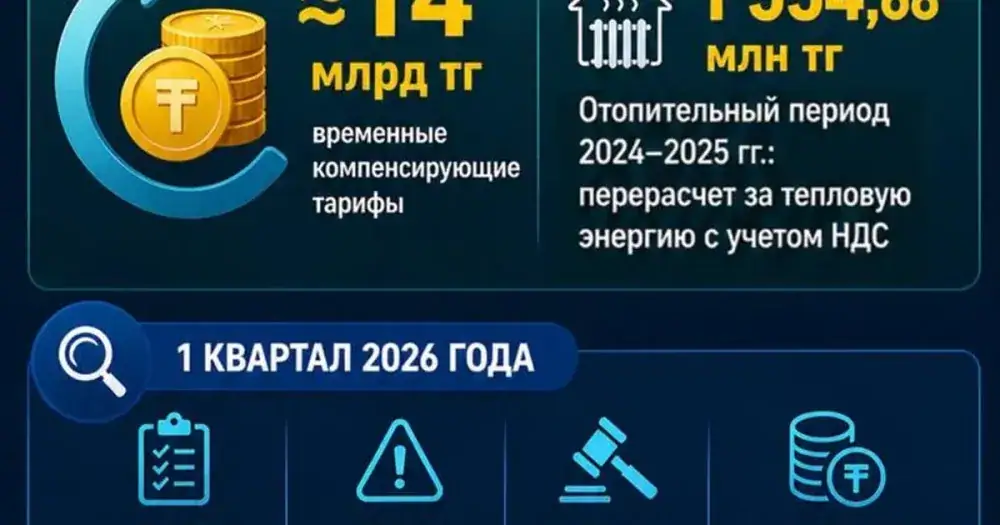
Moreover, there is continuous monitoring of natural monopoly entities' compliance with commitments. This monitoring results in measures such as approved temporary compensating tariffs around 14 billion tenge, providing returns of unutilized funds to consumers.
A noteworthy case is in the Karaganda region, where audit findings showed non-compliance with certain tariff obligations. This will result in more than 3.1 billion tenge being returned to consumers through compensating tariffs.
Also, in the heating supply area by the end of the 2024-2025 heating period, entities operating without measuring devices recalculated heat energy fees amounting to 1,554.68 million tenge, including VAT.
Thus, the tariff regulation system incorporates not only tariff approval but continuous oversight of their implementation. The practice demonstrates that every identified violation results in specific accountability measures, with consumer rights protected by the state.
Reported by ЖКХ24 with reference to the Committee for Regulation of Natural Monopolies under Kazakhstan's Ministry of National Economy.
Photo: gov.kz